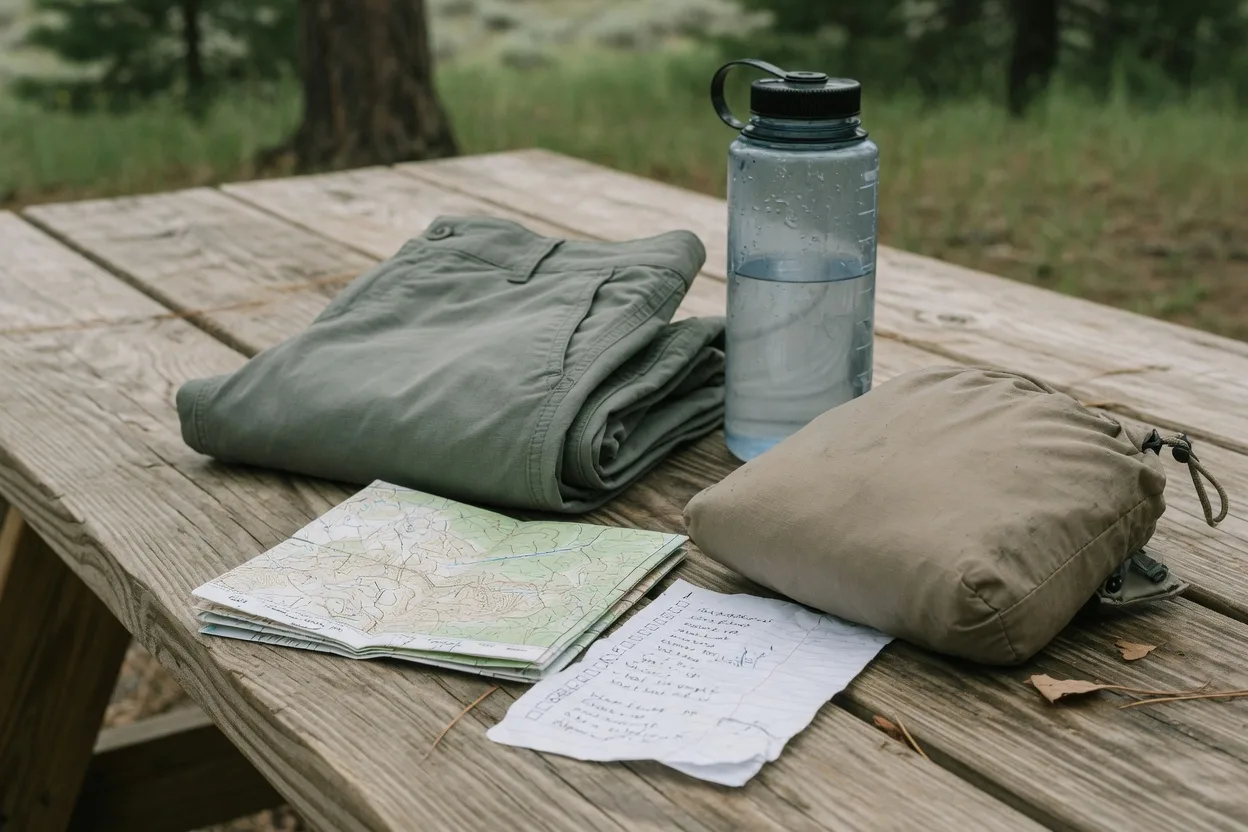
The list is ten systems, not ten objects
The National Park Service describes the Ten Essentials as ten categories, or systems, rather than a fixed shopping list: navigation, sun protection, extra clothing, illumination, first-aid supplies, fire, a repair kit and tools, extra food, extra water with a way to treat it, and emergency shelter. [1] The Deschutes National Forest frames the same list around two basic questions: can you respond positively to an accident or emergency, and can you safely spend a night or more out? [2]
That second question is the one that changes how a beginner packs. A two-hour loop feels too short to need a light or a shelter, but the list exists for the hike that does not go to plan: a twisted ankle, a wrong turn at a junction, or weather that arrives faster than forecast. Olympic National Park calls these items the minimum gear for any wilderness trip and tells visitors to add to the list based on location, time of year and trip length. [3]
What each system means on a day hike
The table below summarizes what the agencies say each system covers, then adds a plain-language note on how it scales. The scaling column is our editorial reading of the sources, not an agency rule.
| System | What the agencies list | Short summer hike (about 2 hours) | Longer or shoulder-season day |
|---|---|---|---|
| Navigation | Map, compass or GPS; know how to use them; paper map as backup; extra phone battery [1] | Downloaded map plus a paper map of the trail | Paper topographic map and compass you have practiced with, plus phone and spare battery |
| Sun protection | Sunglasses, sunscreen, hat; sun-protective clothing [1]; lip balm [2] | Hat, sunglasses, small sunscreen | Same, plus long sleeves on exposed ridges or snow |
| Extra clothing | An extra layer for the most extreme conditions you could face; bright colors help searchers [1] | A light insulating layer and a rain shell | Insulating layer, rain shell, hat and gloves even if the morning is mild |
| Illumination | Headlamp preferred because it is hands-free; extra batteries [1] | Small headlamp | Headlamp with fresh or spare batteries |
| First aid | Premade kit tailored to the trip and your medications; check expiration dates [1] | Blister care, bandages, personal medications | A fuller kit plus any medication you would need overnight |
| Fire | Waterproof matches or lighter plus fire starter; learn local fire rules [1] | Lighter in a zip bag | Lighter plus a separate fire starter |
| Repair kit and tools | Duct tape, knife, scissors, multi-tool; trowel and toilet paper may matter [1] | Small knife and a strip of tape | Knife, tape, spare parts for gear you rely on |
| Nutrition | An extra day's supply of food, preferably no-cook items [1] | Extra snacks beyond what you plan to eat | A meaningful food reserve you do not plan to touch |
| Hydration | Drink before you are thirsty; know water sources you can treat [1]; extra water and purification [2] | Enough water for the hike plus a margin | Water plus a filter or treatment for refills |
| Emergency shelter | Tent, tarp, bivy sack or space blanket [1]; tarp or garbage bag [2] | Emergency blanket or heavy bag | Emergency bivy or tarp |
What beginners commonly skip, and why it matters
Light, shelter and extra clothing are the items most easily rationalized away on a short hike, because each one only matters if you are still out after dark or stopped by an injury. Those are exactly the situations the Forest Service's second question is about. [2] The CDC notes that hypothermia can occur even at cool temperatures above 40 degrees Fahrenheit if a person becomes chilled from rain, sweat or cold water, which is why an extra layer and a shelter belong in a summer pack too. [4]
Navigation is the other common gap. A phone map is useful, and the National Park Service mentions its own app and downloaded maps, but it also recommends a paper map as a backup and an extra battery. [1] Olympic National Park adds that snow can fall in any month of the year in those mountains, so a sunny trailhead in July does not settle what you will meet higher up. [3]
Finally, tell someone where you are going. Olympic National Park advises letting a friend or family member know your route and plans, and says not to rely on a rescue. [3] That costs nothing and is not on the list, but it is what turns an unplanned night out into a search that starts in the right place.
- Headlamp left at home because the hike ends by mid-afternoon
- No shelter because the forecast is clear
- Only the phone for navigation, with no backup map or battery
- Water for the planned hike only, with no reserve or treatment
- No one at home knows the route or expected return time
How much weight does this add?
We have not weighed a kit for this guide, and the agency pages do not publish weights, so we are not quoting per-item numbers. The one figure that is not a product claim is water: one liter weighs about one kilogram, or roughly 2.2 pounds, so water is usually the heaviest item you choose to carry.
A practical approach is to weigh your own kit once on a kitchen scale, grouped by system, and write the totals down. That shows you where the weight actually is before you consider buying lighter versions of anything. Most of the non-water systems on a day hike are small items; the ones that grow fastest with season are extra clothing and water.
| Item group | Weight to record | Usually changes with |
|---|---|---|
| Water | About 1 kg per liter carried | Heat, distance, availability of treatable sources |
| Extra clothing | Weigh your own layers | Season and elevation |
| Food reserve | Weigh your own | Trip length |
| Navigation, light, fire, repair, first aid | Weigh as one pouch | Rarely; keep it packed between trips |
| Emergency shelter | Weigh your own | Remoteness and weather |
Pre-hike checklist
Use this the night before, not at the trailhead. If an item is missing, solve it with what you already own before buying anything; a garbage bag is on the Forest Service list as an emergency shelter option. [2]
- Map of the route downloaded and a paper copy packed; compass or GPS you know how to use
- Hat, sunglasses, sunscreen and lip balm
- One extra insulating layer and a rain shell, chosen for the worst conditions you might meet
- Headlamp tested, with spare batteries
- First-aid kit checked for expired items; personal medications added
- Lighter or waterproof matches plus a fire starter; local fire rules checked
- Knife and a little duct tape
- Food beyond what you plan to eat
- Water for the hike plus a margin, and a way to treat refills
- Emergency blanket, bivy, tarp or heavy bag
- Route and expected return time left with someone at home
Questions before you decide
Do I really need all ten on a short, popular trail?
Olympic National Park calls the list the minimum gear for any wilderness trip and tells hikers to add to it for location, time of year and trip length. Shorten the quantities on an easy hike, not the categories.
Is a phone enough for navigation?
The National Park Service mentions downloaded maps and its app but also recommends a paper map as a backup and an extra phone battery, and says to know how to use a map, compass or GPS before you go.
What counts as emergency shelter on a day hike?
The National Park Service lists a tent, tarp, bivy sack or emergency space blanket. The Deschutes National Forest list includes a tarp or a garbage bag.
Sources & verification
Product details and prices can change. Check the linked provider before buying.
- National Park Service: 10 Essentials Accessed 30 Oct 2026
- USDA Forest Service, Deschutes National Forest: Hiking and Backpacking Essentials Accessed 30 Oct 2026
- Olympic National Park: Wilderness Travel Basics Accessed 30 Oct 2026
- CDC: Preventing Hypothermia Accessed 30 Oct 2026
Sources link directly to providers. Product buttons may use separately labeled affiliate links. Read our disclosure.